
Global Low Voltage partners with custom home builders, general contractors, and property developers to design and install structural wiring during the framing stage of construction. Operating throughout Greater Los Angeles—from luxury estates in Beverly Hills to modern corporate build-outs in the San Fernando Valley—we ensure your property is fully equipped for today’s smart technology.
No phone trees. No high-pressure sales. Just clear answers from people who do this every day.
Retrofitting cables behind finished walls is intrusive, time-consuming, and expensive—often costing 3 to 5 times more than running wires during the “rough-in” phase. By engaging us early in your new build or “down-to-the-studs” remodel, we install the centralized wiring backbone needed for flawless Wi-Fi, whole-home audio, automated lighting, and high-definition security cameras.
We coordinate directly with your architect and electrical contractor to map out pathways, ensuring low-voltage lines are run at proper distances from line-voltage electrical to prevent electromagnetic interference (EMI).
We prepare your luxury residence or corporate boardroom for high-end audio and video. We pull 16/2 or 14/2 speaker wire to exact acoustic locations for surround sound, run fiber-optic HDMI to projector locations, and prep for motorized shades and lighting control panels.
We work seamlessly with your General Contractor, electricians, and HVAC teams to ensure our rough-in happens exactly when needed, keeping the master schedule on track.
We route all low-voltage lines at strict perpendicular angles and safe distances from high-voltage Romex to guarantee flawless signal integrity and zero data loss.
Every single cable is precisely labeled at both the drop and the head-end. When the drywall goes up, the final trim-out phase will be lightning-fast and error-free.
We don't just wire for today's tech. We engineer the infrastructure to handle 8K video, Wi-Fi 7, and the heavy bandwidth demands of tomorrow's smart environments.
All structured wiring is pulled to strict NEC and California Title 24 standards. We never cut corners on fire-stopping, drilling limits, or structural integrity.
We take immense pride in our stud bays. Cables are neatly bundled, secured with proper J-hooks or staples, and protected with nail plates to prevent drywall screw damage.
Cabinet Installation of recessed structured wiring enclosures to serve as the organized "brain" for the property's network, security, and AV distribution.
Flexible ENT conduit run from the central AV closet to key media locations, allowing you to easily pull new fiber or data cables in the future without cutting drywall.
High-bandwidth Cat6a drops strategically routed to ceiling WAP (Wireless Access Point) locations to guarantee zero dead-zones across the entire footprint.
Premium 14/2 or 16/2 speaker wire pulled for multi-zone architectural audio, plus fiber-optic HDMI prep for flawless 4K/8K display distribution.
Camera or Lock PoE (Power over Ethernet) lines pulled to exterior soffits for IP cameras, and localized wiring for smart doorbells, access control panels, and alarm sensors.
Weather-rated subterranean conduit and wire prep for patio audio, outdoor Wi-Fi access points, and perimeter security surveillance.
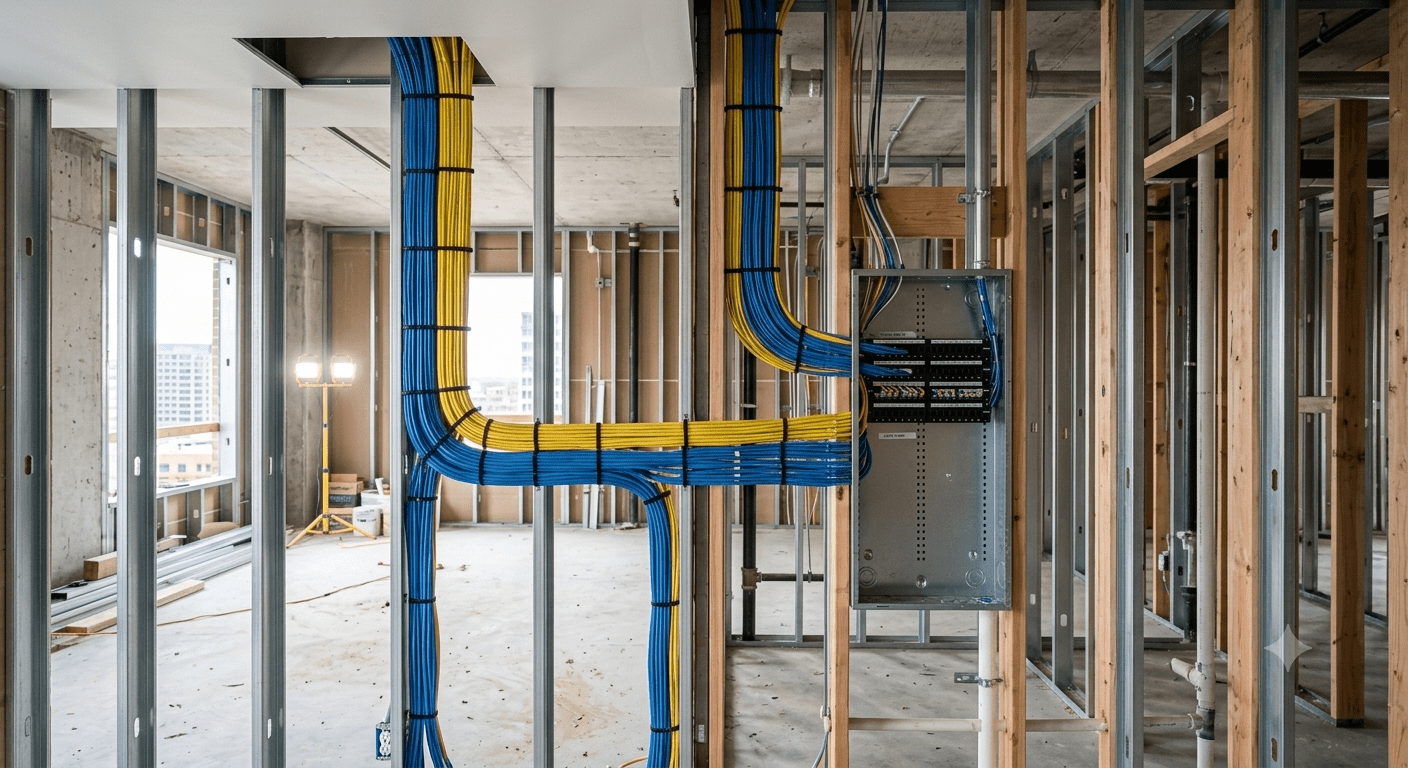
We don't just show up and pull wire. We review your architectural blueprints and coordinate early with high-voltage electricians and HVAC teams to ensure our low-voltage pathways don't conflict with other trades.
Before drilling a single hole, a lead technician walks the open studs to map out the central MDF (Server Room) location, mark drop points, and plan safe parallel distances from Romex to prevent future EMI (interference).
We execute the rough-in. Our technicians drill clean, code-compliant holes through wood or metal framing and pull the required structured cabling (Cat6a, fiber optic, access control wire) to every specified endpoint.
We take stud-bay organization seriously. All cables are neatly bundled, secured with proper J-hooks or staples, and rigorously protected with metal nail plates on the studs to prevent any damage from drywall screws.
Every single wire is precision-labeled at both the device drop and the head-end. We leave the property perfectly organized and prepped for a fast, error-free trim-out phase once the paint and drywall are finished.
Low-voltage pre-wiring (the “rough-in” phase) must be scheduled immediately after the high-voltage electrical, plumbing, and HVAC rough-ins are complete, but strictly before insulation and drywall are installed. This allows our technicians to run structured cabling through open framing while maintaining required distances from high-voltage lines to prevent electromagnetic interference (EMI).
A centralized enclosure, often referred to as a Main Distribution Frame (MDF) or Smart Panel, is the physical hub where all low-voltage wiring terminates. Instead of scattering modems, switches, and camera NVRs throughout a property, we run every Cat6, fiber, and coaxial cable back to a single, climate-controlled server rack or recessed wall enclosure for clean aesthetics and centralized management.
For modern commercial builds and luxury estates in Los Angeles, Cat6a is the strict standard. While standard Cat6 supports 10 Gigabit speeds over short distances (up to 55 meters), Cat6a features superior shielding and maintains full 10 Gigabit bandwidth across the entire 100-meter standard. This future-proofs the property for Wi-Fi 6E/7, 8K video routing, and heavy Power over Ethernet (PoE) loads.
Yes. Technology evolves rapidly, and replacing cables behind finished drywall is exceptionally expensive. We install flexible Electrical Nonmetallic Tubing (ENT)—commonly called “Smurf Tube”—from the central server rack to critical endpoint locations. This creates a permanent, protected pathway inside the walls, allowing you to easily pull new fiber optic or data cables years down the road without cutting drywall.
We strictly adhere to NEC and TIA/EIA standards. High-voltage electrical lines emit electromagnetic fields that can corrupt data packets on network cables. We route all low-voltage structured cabling at safe parallel distances from Romex, and when cables must cross, we engineer them to intersect at strict 90-degree perpendicular angles to guarantee zero signal loss or data corruption.